



Case Studies / Auto-Generate Product Manuals at Scale — 30,000+ Templates
Business Systems · Manufacturing · AI

Auto-Generate Product Manuals at Scale — 30,000+ Templates

A manufacturer needed user manuals for tens of thousands of product models. Manual production was completely impractical at catalog scale — each product had unique specs but followed standardized documentation formats.

Tech Stack
ruby-on-rails react-2 flutter openai postgre aws pdf
Project Info
Platform Web (internal tool)
User Type Internal (documentation team)
Client Type Enterprise
Engagement Fixed Price
Region Japan
Auto-Generate Product Manuals at Scale — 30,000+ Templates

The Challenge

Writing user manuals for 30,000 product models is not a documentation problem — it is a math problem. At any reasonable pace, a documentation team would take years to cover the full catalog. And the catalog grew faster than the team could write.

Each product model had unique specifications, but the documentation format was consistent across the range: same sections, same structure, same safety language — only the product details changed. The work was enormously repetitive, and enormously time-consuming, for exactly that reason.

What We Built

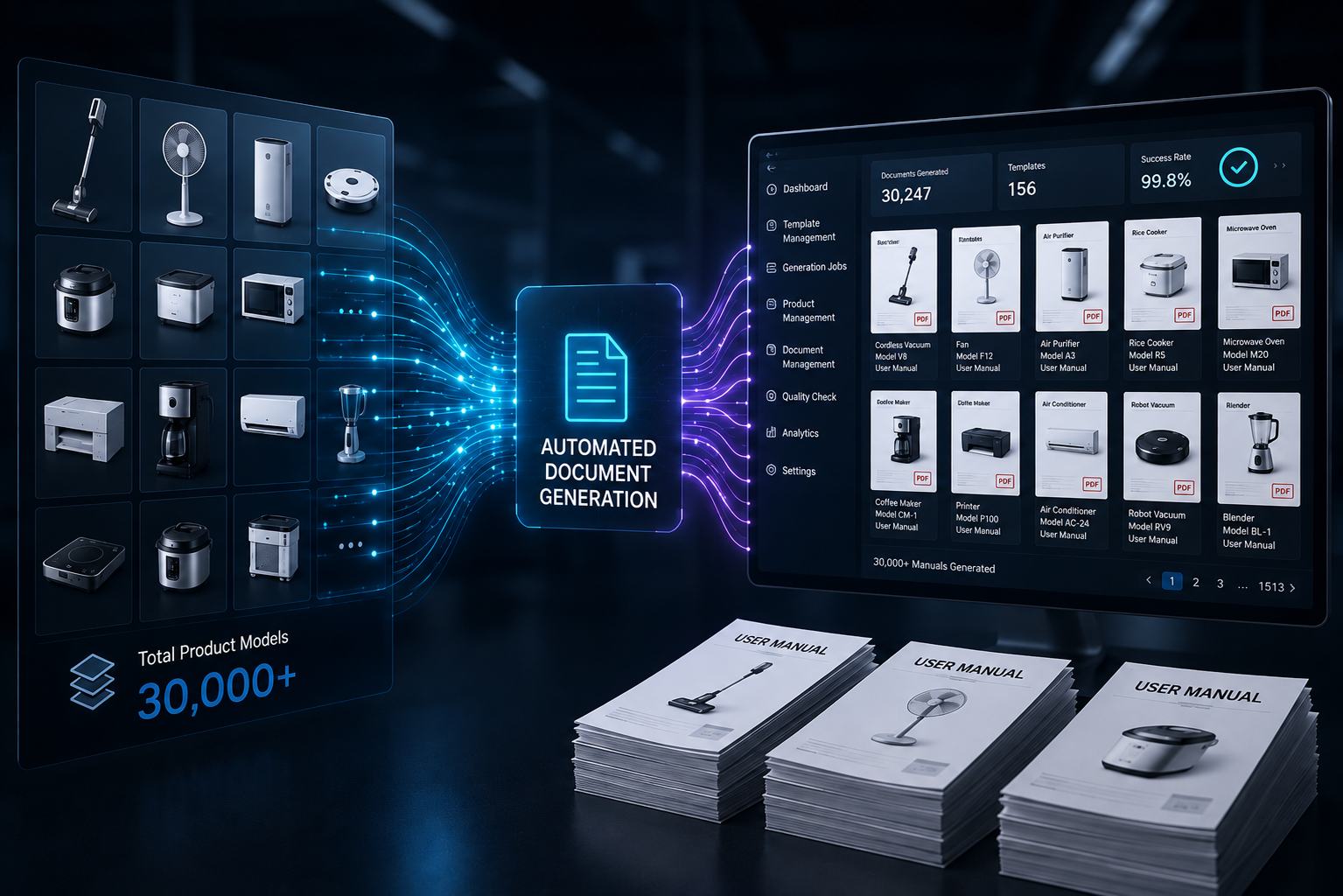
AMCOLAB built a documentation engine: product specs go in, formatted manuals come out. The documentation team shifted from writing to reviewing — a significantly smaller workload, with much better coverage of the catalog.

Spec Database Ingestion
01

Spec Database Ingestion

Product specifications import from the client's catalog database via API or structured CSV. Fields map to documentation components — dimensions, safety classifications, operating conditions, warnings, and use cases.


AI-Assisted Content Generation
02

AI-Assisted Content Generation

AI generates the narrative sections of each manual from structured spec data. Boilerplate content — safety notices, warranty language, regulatory statements — is templated and injected. The AI handles only the variable, product-specific prose.

Section Logic Engine
03

Section Logic Engine

Rules determine which sections apply to each product category. A refrigerator manual includes defrost instructions; a countertop appliance does not. Rules are configurable by the documentation team without code changes.

Multi-Language Output
04

Multi-Language Output

Japanese and English versions are generated simultaneously from the same data source. Terminology stays consistent across languages because translation operates at the data layer.

Batch Processing & Export
05

Batch Processing & Export

The documentation team triggers generation runs by product category, monitors progress, and downloads finished PDFs and HTML files from a dashboard — without developer involvement for routine operations.

Key Outcomes

30,000+ product manuals generated — production time reduced from weeks per batch to hours

Documentation team focus shifted to reviewing and approving rather than writing from scratch

Catalog coverage expanded — previously backlogged models are now covered

Format consistency enforced across the full product range — no manual inconsistencies between product lines

New product launches can produce documentation on the same day specs are finalized

Delivery Scope

Requirement Definition Architecture Development Integration QA Deployment Maintenance

Why AMCOLAB

AI-native development

content generation pipeline designed around production use, not prototype quality

Manufacturing context

experience with structured spec data, regulatory documentation requirements, and multi-language output for the Japan market

Full-cycle delivery

requirements through deployment, with ongoing template updates

Practical scope

we built what the documentation team could actually operate, not a tool that required developer involvement for every run

RELATED WORK

More projects

Start A Project

Managing documentation at catalog scale?

Let's automate the repetitive part and let your team focus on the decisions.

Schedule a Meeting Now
Hotline
Email