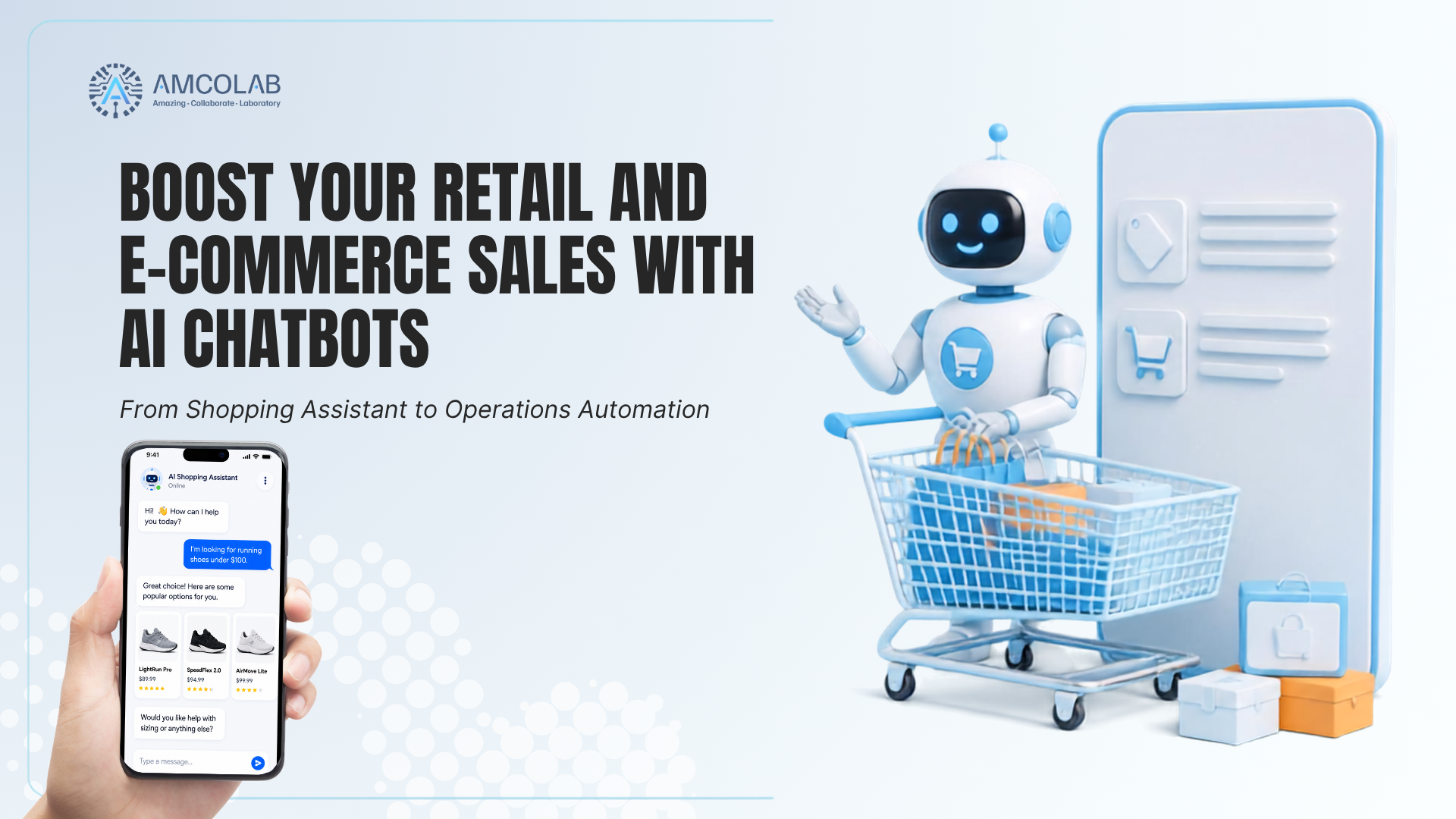
BOOST YOUR RETAIL AND E-COMMERCE SALES WITH AI CHATBOTS: FROM SHOPPING ASSISTANT TO OPERATIONS AUTOMATION
This blog explores how AI chatbots are transforming Retail and E-commerce from simple customer support tools into intelligent sales and operations platforms. Powered by LLMs, RAG, real-time APIs, and workflow automation, AI chatbots can personalize product recommendations, recover abandoned carts, automate post-purchase support, and capture valuable zero-party customer data.
Traffic surges during major campaigns, but conversion rates remain stubbornly flat. Customer service costs increase sharply during peak seasons, yet customers still experience fragmented support, delayed responses, and inconsistent purchasing journeys. For many Retail and E-commerce businesses, this is no longer an occasional operational challenge; it has become a structural problem that directly affects both revenue and customer experience.
At the same time, customers are becoming increasingly impatient with digital friction. They expect businesses to understand their questions immediately, provide relevant product recommendations, and resolve simple issues without requiring them to navigate through multiple pages or wait for a customer service agent. Traditional rule-based chatbots were designed for a very different environment. They work well when conversations follow predefined scenarios, but quickly become frustrating when customers ask questions outside those scenarios or express their needs in natural, unexpected language.
This is where Conversational AI is changing the role of chatbots in modern commerce.
Powered by Large Language Models (LLMs), Retrieval-Augmented Generation (RAG), real-time APIs, and intelligent workflow automation, today's AI chatbots can do far more than answer frequently asked questions. They can understand customer intent, recommend products based on individual needs, recover potentially lost sales, retrieve real-time order information, initiate post-purchase workflows, and collect valuable customer insights through natural conversations.
In other words, the chatbot is evolving from a simple customer support tool into a 24/7 digital sales assistant and an intelligent operational layer for the entire e-commerce ecosystem.
Why Traditional E-Commerce Experiences Are No Longer Enough
The modern customer journey is increasingly fragmented. A shopper may discover a product through social media, visit the retailer's website to learn more, compare several alternatives, ask a question through Messenger, and then return to the website to complete the purchase. Each interaction generates valuable context, yet these interactions are often handled by separate systems that do not share information effectively.
The result is an experience in which the customer is frequently required to do the work that the business's technology should be doing for them.
A customer searching for a dress, for example, may know that they want something suitable for an autumn event, prefer a particular color, have a specific budget, and need a certain style or fit. However, a conventional search interface expects the customer to translate all of those requirements into categories, keywords, and filters.
Conversational AI changes this interaction by allowing customers to express their needs naturally.
Instead of navigating through a complex product catalog, they can simply say:
“I'm looking for a green evening dress with a relaxed fit, suitable for cooler weather, and under $100.”
The AI can interpret the customer's intent, identify the relevant product attributes, search the retailer's catalog, and present the most appropriate options. If necessary, it can continue the conversation and ask additional questions to refine the recommendation.
This is much closer to the experience of speaking with a knowledgeable sales associate than using a conventional search engine.
The difference becomes even more valuable when the AI is connected to the retailer's real-time systems. It can move from recommending products to checking inventory, answering questions about delivery, explaining return policies, and helping customers complete transactions.
That is where Conversational AI begins to have a direct impact on both customer experience and revenue.
Four High-Impact Applications of AI Chatbots in E-Commerce
Personalized Shopping Assistance
Customers are not simply buying products; they are making decisions. The more complex the purchase, the more valuable guidance becomes.
An AI-powered shopping assistant can understand natural language and interpret the context behind a customer's request rather than relying on fixed keywords. A shopper no longer needs to know exactly which product category or technical specification corresponds to their needs. They can simply describe what they are looking for.
For example, a customer might ask:
“Can you find me a green dress for a wedding, with a flattering fit, under $1.5 million?”
The AI can identify the relevant attributes, retrieve matching products from the catalog, and explain why those products are suitable. If the customer then asks for something more formal or specifies a preferred size, the system can refine the recommendation without forcing the customer to start the search again.
This conversational approach also creates new opportunities for cross-selling and upselling. Once a customer has selected a particular product, the AI can understand the context of that purchase and recommend complementary products. A fashion retailer might suggest a belt and shoes that complete the outfit, while an electronics retailer could recommend compatible accessories or an extended warranty.
The important difference is that these recommendations are generated within the context of an actual conversation. Instead of simply displaying a generic “Customers also bought” section, the system can explain why a particular product may be relevant to that individual customer.
The result is a shopping experience that feels more personal while creating additional opportunities to increase conversion and average order value.
Recovering Abandoned Carts Through Contextual Conversations
Abandoned carts represent one of the most persistent challenges in E-commerce. Customers often leave products behind for reasons that are not immediately visible to the retailer: unexpected shipping costs, uncertainty about product suitability, concerns about returns, difficulty using a promotion, or simply a lack of confidence in the purchase decision.
Traditional cart recovery campaigns tend to treat these customers in much the same way. An automated email or notification reminds them that they still have products in their cart and encourages them to complete checkout.
Conversational AI can make the recovery process considerably more intelligent.
Instead of sending another generic reminder, an AI assistant can initiate a contextual conversation through channels such as the website, Zalo OA, Facebook Messenger, or other messaging platforms. The conversation can reference the customer's existing cart and provide assistance based on the customer's actual concerns.
For example:
“Hi An, the lipstick in shade 02 you were looking at is still in your cart, and only a few units remain. Would you like help checking whether this shade is suitable for your skin tone?”
If the customer responds that they are unsure about the color, the AI can provide relevant product information. If the customer is concerned about delivery costs, it can explain the available shipping options. If they are uncertain about the return policy, the assistant can provide the relevant information without requiring them to leave the conversation.
The objective is not simply to remind customers that they have abandoned a cart. It is to understand what is preventing them from completing the purchase and remove that friction as quickly as possible.
This transforms cart recovery from a marketing automation task into an intelligent sales conversation.
Automating Post-Purchase Operations
The customer journey does not end when an order is placed. In many E-commerce businesses, a substantial amount of customer service workload comes from repetitive post-purchase questions, particularly around delivery status, returns, refunds, and order changes.
Customers frequently ask variations of the same question: “Where is my order?”
This type of request, often referred to as WISMO—“Where Is My Order?”—may appear simple, but answering it manually can consume a significant amount of customer service capacity, particularly during peak periods.
An AI chatbot connected to the retailer's order management and logistics systems can retrieve this information automatically. Rather than directing the customer to a generic tracking page, the assistant can access the relevant order and provide a clear explanation of its current status.
For example:
“Your order was shipped yesterday and is currently being processed at the regional distribution center. Based on the latest carrier update, it is expected to arrive tomorrow.”
The same approach can be applied to returns and refunds.
If a customer wants to return a product, the AI can retrieve the relevant order, check the applicable return policy, determine whether the order meets the required conditions, guide the customer through the process, and trigger the appropriate workflow when permitted.
For businesses operating in Vietnam, this can also involve integrations with local logistics providers and e-commerce infrastructure, allowing the chatbot to work with real operational data rather than relying on static responses.
The result is a support operation that can handle a much larger volume of routine interactions without requiring the customer service team to scale linearly with order volume.
Turning Conversations Into Zero-Party Customer Data
Customer data has always been one of the most valuable assets in E-commerce, but the way businesses collect and use that data is changing.
Behavioral data can tell a retailer what a customer did. It can show which products they viewed, which pages they visited, and which items they eventually purchased. However, behavioral data does not always explain the customer's underlying preferences or motivations.
Conversational AI creates an opportunity to collect this information directly.
During a natural conversation, customers may voluntarily reveal their preferred styles, sizes, budgets, shopping intentions, product preferences, or specific needs. A fashion customer might explain that they prefer minimalist clothing and neutral colors. A customer buying furniture might mention that they are furnishing a small apartment and therefore prioritize compact products.
This is known as Zero-Party Data: information that customers intentionally and directly provide to a brand.
When appropriately captured and managed, this information can enrich CRM or Customer Data Platform systems and support more relevant future interactions. The next time the customer returns, the AI can use these preferences to make recommendations that are more closely aligned with what the customer has actually told the business.
The conversation therefore becomes more than a support interaction. It becomes another channel through which the business can understand its customers.
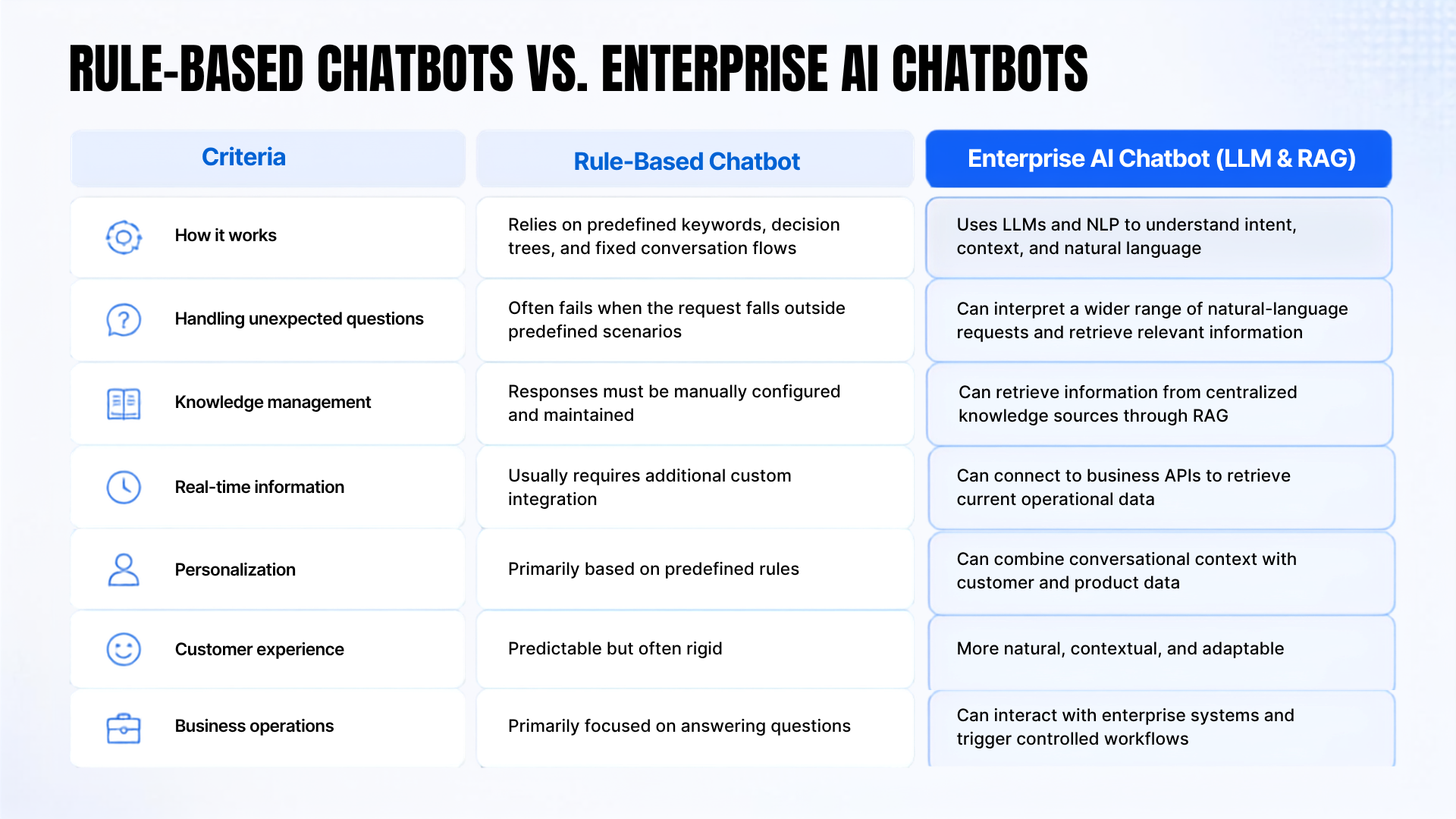
Rule-Based Chatbots vs. Enterprise AI Chatbots
The difference between traditional rule-based chatbots and modern AI chatbots is not simply that one sounds more natural than the other. The underlying architecture and capabilities are fundamentally different.
Criteria | Rule-Based Chatbot | Enterprise AI Chatbot (LLM & RAG) |
How it works | Relies on predefined keywords, decision trees, and fixed conversation flows | Uses LLMs and NLP to understand intent, context, and natural language |
Handling unexpected questions | Often fails when the request falls outside predefined scenarios | Can interpret a wider range of natural-language requests and retrieve relevant information |
Knowledge management | Responses must be manually configured and maintained | Can retrieve information from centralized knowledge sources through RAG |
Real-time information | Usually requires additional custom integration | Can connect to business APIs to retrieve current operational data |
Personalization | Primarily based on predefined rules | Can combine conversational context with customer and product data |
Customer experience | Predictable but often rigid | More natural, contextual, and adaptable |
Business operations | Primarily focused on answering questions | Can interact with enterprise systems and trigger controlled workflows |
However, this comparison should not lead to the misconception that simply adding an LLM automatically creates an enterprise-ready AI chatbot.
The model itself is only one component of the solution.
The real value comes from connecting the model to the right knowledge, data, business rules, and operational systems.
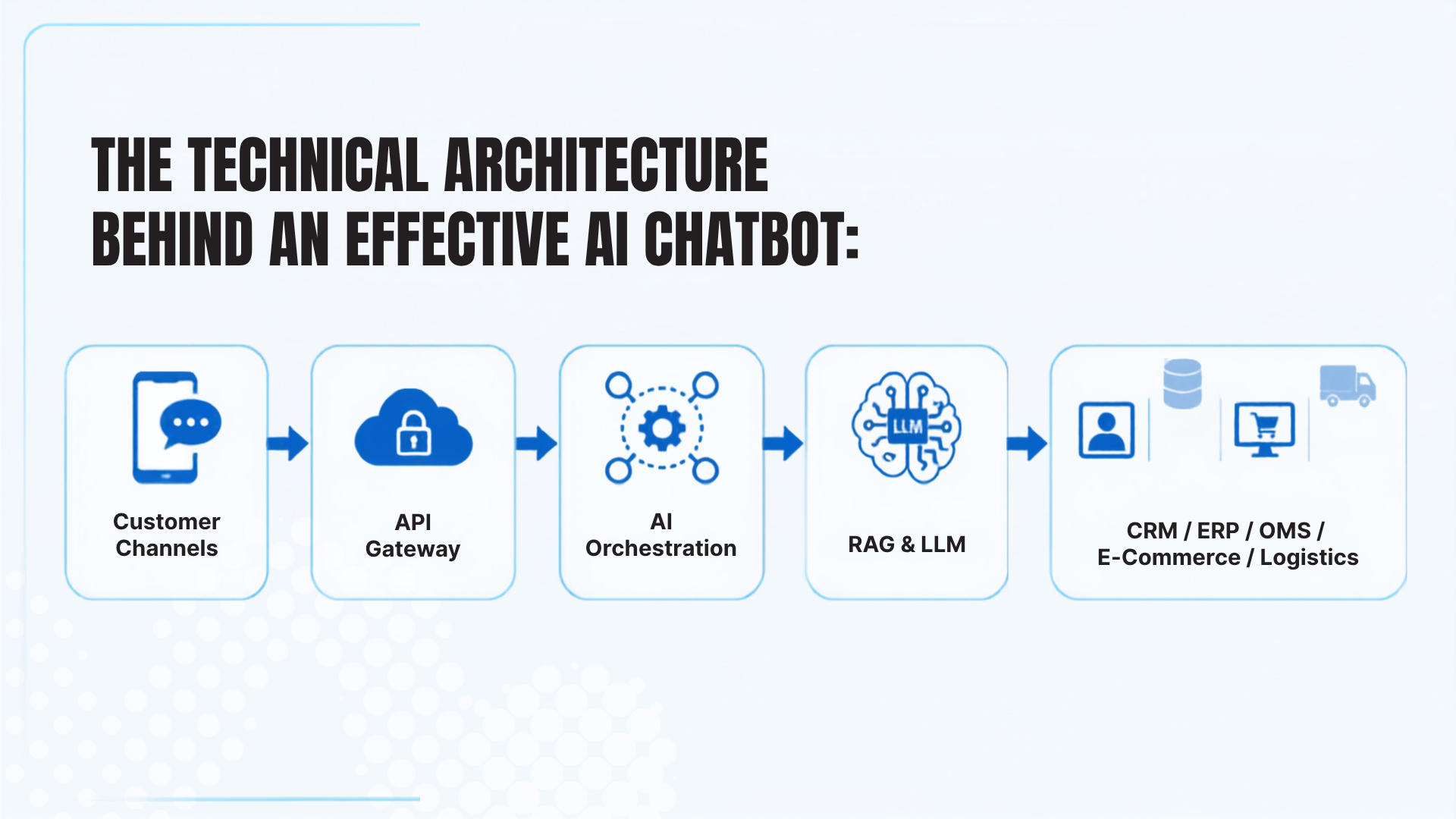
The Technical Architecture Behind an Effective AI Chatbot
A production AI chatbot for E-commerce needs to operate across multiple systems while maintaining a consistent customer experience. The architecture therefore needs to address far more than the conversational interface.
A typical implementation can be viewed as a flow from the customer-facing channels through an API and orchestration layer into the AI and knowledge infrastructure, and finally into the enterprise systems responsible for business operations.
Customer Channels → API Gateway → AI Orchestration → RAG & LLM → CRM / ERP / OMS / E-Commerce / Logistics
The customer may interact with the system through a website, mobile application, Zalo OA, Facebook Messenger, or another channel. Behind those interfaces, a centralized conversational layer manages customer context and routes requests to the appropriate AI capabilities and business services.
This architecture is particularly important for omnichannel commerce. A customer may begin a conversation on the website and later receive an order update through Zalo. Without a shared customer and conversation context, each channel becomes an isolated experience. With a properly designed architecture, the business can maintain continuity across channels while keeping the underlying data synchronized.
The AI layer itself should also be grounded in reliable enterprise data.
RAG can connect the language model to product information, FAQs, policies, and internal documentation, allowing the system to retrieve relevant information before generating a response. At the same time, real-time API integrations can provide dynamic information such as inventory levels, order status, shipping information, and customer-specific transaction data.
This combination is essential because an AI model should not be expected to “remember” information that changes continuously.
If a customer asks about a product's current inventory, the answer should come from the inventory system. If the customer asks about their order, the answer should come from the order management or logistics system. RAG provides contextual knowledge, while APIs provide real-time operational truth.
The distinction is fundamental to building reliable enterprise AI.
Human-in-the-Loop: Knowing When AI Should Hand Over to a Human
Automation should not mean removing humans from the customer experience entirely. In fact, the most effective AI customer service systems are designed to recognize situations where human intervention is more appropriate.
Sentiment analysis can be used as one signal in this process. If a conversation begins as a simple product question but gradually becomes increasingly negative or frustrated, the system can recognize the change in sentiment and escalate the conversation.
The same principle applies when the request falls outside the AI's confidence level or requires an exception to standard business rules.
Instead of simply responding that it cannot help, the AI can transfer the conversation to a customer service representative while preserving the full conversational context. The human agent can then see what the customer asked, what information the AI retrieved, and which steps have already been completed.
This significantly reduces the friction of human handover.
The objective is not to automate every interaction. It is to automate the interactions that can be handled reliably while ensuring that complex or sensitive situations reach the right person as quickly as possible.
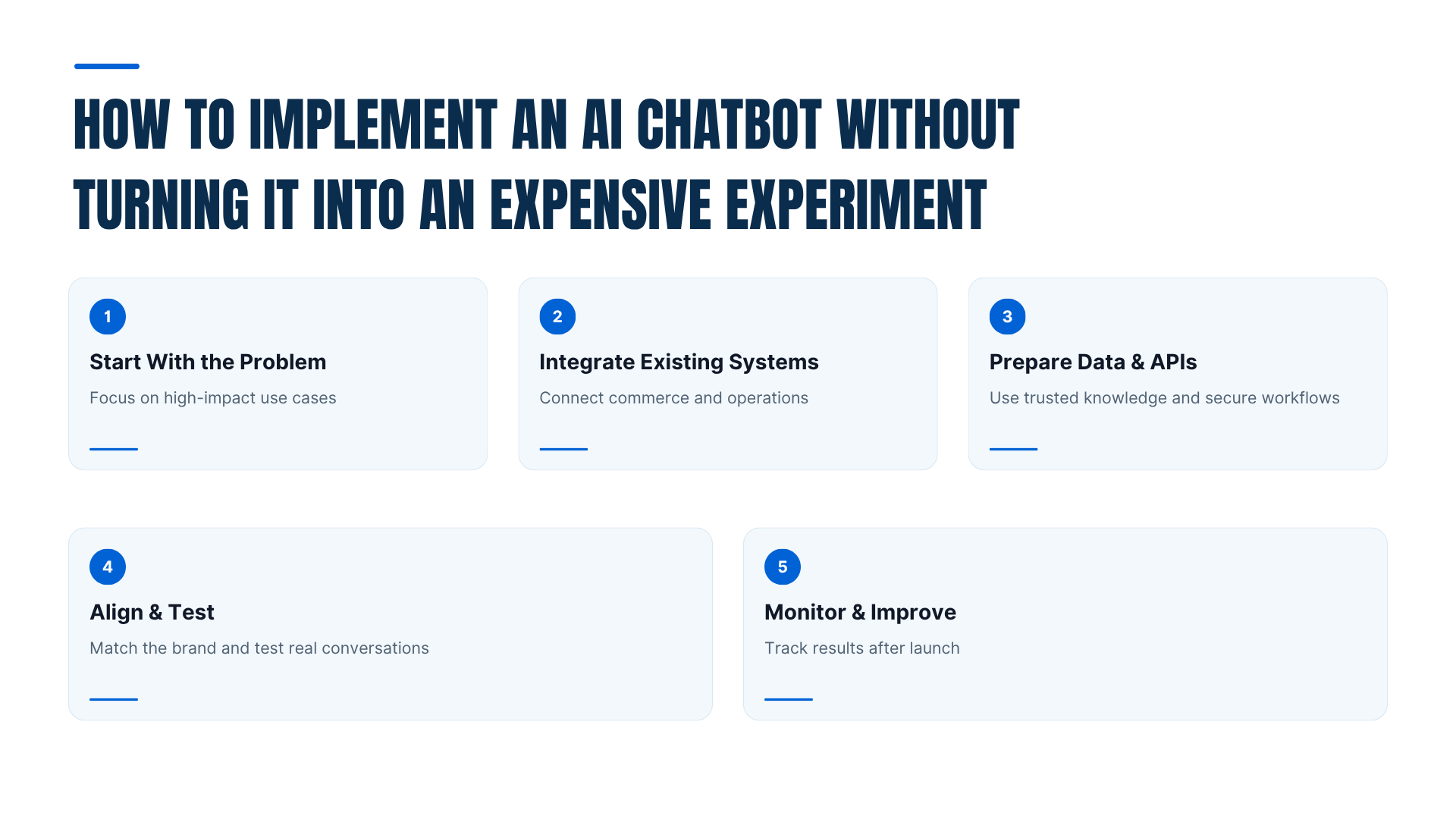
How to Implement an AI Chatbot Without Turning It Into an Expensive Experiment
The difference between a promising AI demo and a production system usually comes down to implementation discipline.
At AMCOLAB, the starting point is not the LLM. It is a business problem.
The first step is to analyze existing customer service data, sales funnels, and operational workflows to identify where customers experience the most friction and where automation can generate measurable value. Instead of trying to automate every possible conversation, businesses can begin with a focused set of high-volume, high-impact use cases.
Once those priorities are established, the next challenge is architecture. The AI solution needs to be designed around the company's existing E-commerce platform and operational infrastructure, whether that means Shopify, WooCommerce, Magento, a custom commerce platform, or an internal CMS. The objective is to integrate AI into the existing business rather than create another isolated system.
The knowledge layer must then be prepared carefully. Product information, policies, FAQs, and internal documentation need to be structured so that the AI can retrieve accurate information when it needs it. At the same time, transactional workflows should be exposed through secure APIs so that the AI can access real-time data and execute approved actions without bypassing business logic.
The conversational experience also needs to reflect the brand itself. An AI assistant for a premium fashion brand should not communicate in exactly the same way as an AI assistant for a consumer electronics retailer. Tone, terminology, escalation rules, and response behavior should all be aligned with the brand's identity and customer expectations.
Testing is another critical stage. Production AI systems need to be evaluated against realistic customer conversations, ambiguous requests, edge cases, hallucination risks, prompt injection attempts, data privacy concerns, and failure scenarios. A chatbot that performs well in a controlled demo may behave very differently when exposed to thousands of unpredictable customer conversations.
Finally, the system should be continuously monitored after launch. Conversion rate, customer satisfaction, first-contact resolution, escalation rate, response accuracy, cost per ticket, and other business metrics provide the feedback required to improve the system over time.
AI implementation should therefore be treated as an ongoing product and engineering process rather than a one-time deployment.
From AI Chatbot to an Intelligent Commerce Layer
The most important shift happening in E-commerce is not the arrival of another chatbot.
It is the emergence of a new interface between customers and business systems.
When a customer asks for a product recommendation, the AI can understand their needs and connect them to the right products. When they hesitate before checkout, it can identify and address the friction that prevents conversion. When they ask about an order, it can retrieve real-time information. When they need to return a product, it can guide them through the process and trigger the appropriate workflow. And when a situation becomes too complex for automation, it can bring a human into the conversation with the relevant context already available.
This is why the future of Conversational AI in Retail and E-commerce extends far beyond customer support.
The real opportunity lies in connecting conversation, customer data, AI reasoning, and business operations into one intelligent system.
For retailers, that can mean a better shopping experience, more personalized engagement, lower customer service costs, faster resolution times, and ultimately a more scalable path to revenue growth.
The companies that gain the most from this technology will not necessarily be those that deploy the most powerful LLM. They will be the companies that connect AI deeply enough to their existing commerce infrastructure to make the technology useful in the moments that matter.
At AMCOLAB, we help businesses turn this vision into production-ready systems by combining AI engineering with E-commerce development, API integration, RAG architecture, automation, and enterprise system integration.
Because an AI chatbot should not exist simply to answer questions.
It should understand what the customer needs, connect that intent to the right business systems, and help move the business forward.