The Hidden Cost of Hiring the Cheapest Developers
The cheapest developer may launch Version 1, but who will maintain Version 5? Discover the hidden costs of low-cost software development and why sustainable engineering matters for business growth.
The Hidden Cost of Hiring the Cheapest Developers
When starting a software project, it's natural to look at cost first.
A founder receives three proposals.
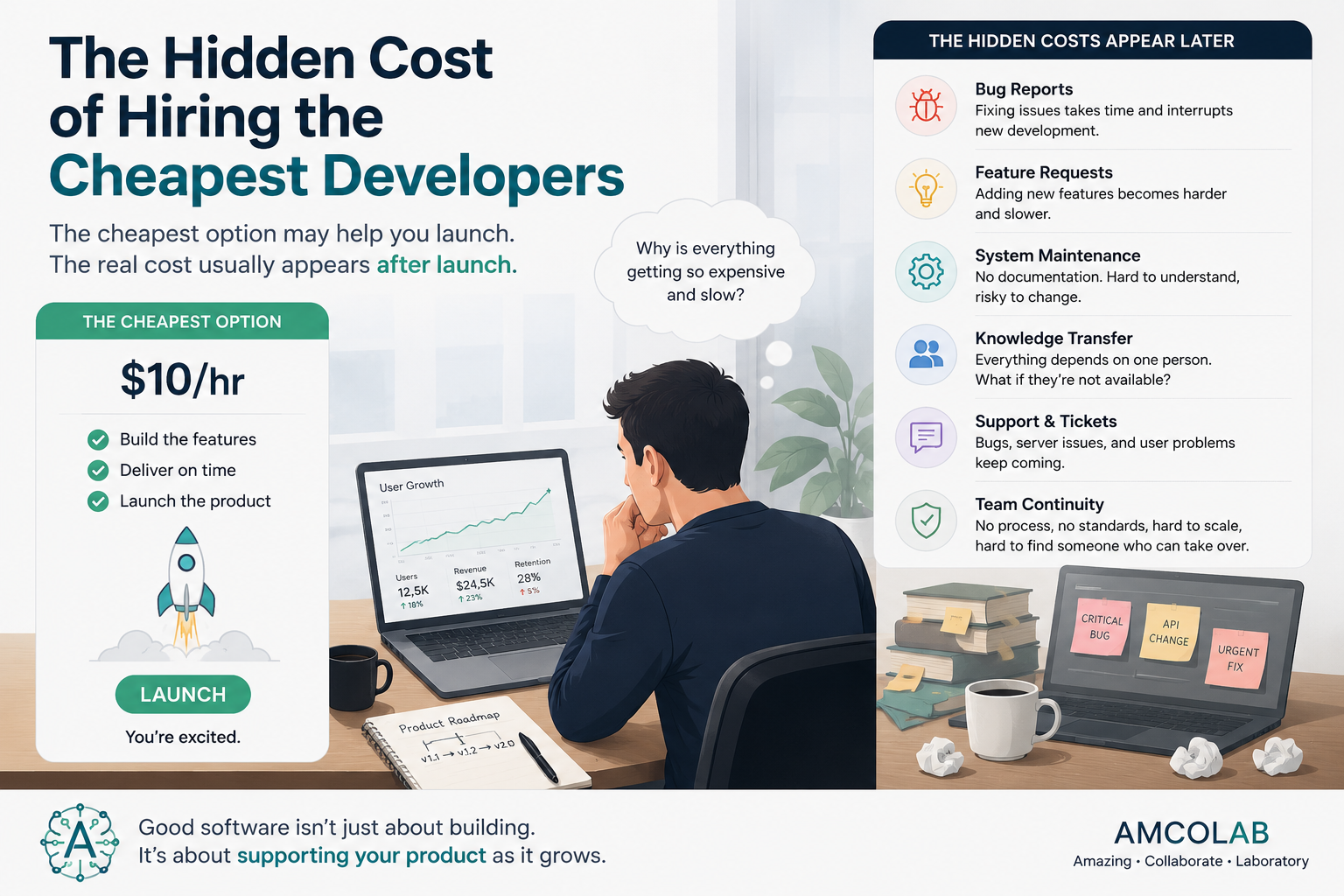
One team charges $10/hour.
Another charges $25/hour.
A third charges $40/hour.
At first glance, the decision seems obvious.
If all of them can build the same product, why pay more?
It's a reasonable question.
The problem is that software projects rarely reveal their true cost during development.
The hidden costs usually appear much later.
The Product Works. Then Reality Starts.
Most software projects look successful in the beginning.
The screens are completed.
The features work.
Users can sign up.
Payments go through.
The product launches.
Everyone is happy.
The challenge starts when the business begins to evolve.
A customer requests a new feature.
Users report bugs.
A third-party service changes its API.
The onboarding flow needs improvement.
Mobile operating systems release updates.
The business discovers new requirements that weren't obvious on day one.
This is where software becomes more than code.
It becomes a living product.
The Cost Nobody Includes in the Proposal
Over the years, we've reviewed and taken over many existing systems.
Some were built by freelancers.
Some by agencies.
Some by internal teams.
Interestingly, the biggest problems are rarely related to coding ability.
The real issues are often:
- No documentation
- Little understanding of why certain decisions were made
- Knowledge concentrated in one person
- No review process
- No testing process
- No release workflow
- No long-term ownership
The application still works.
But every future change becomes slower, riskier, and more expensive.
What initially looked like a cost saving often becomes an operational burden.
The Most Expensive Project Is Usually the One That Needs Rebuilding
One pattern appears surprisingly often.
A product launches successfully.
The business grows.
Then six or twelve months later, nobody wants to touch the system anymore.
Adding features becomes difficult.
Fixing bugs becomes unpredictable.
Every change risks breaking something else.
Eventually, the conversation shifts from:
"How do we improve the product?"
to:
"Should we rebuild it?"
At that point, the original savings disappear very quickly.
What Businesses Actually Need
Most businesses are not buying code.
They're buying confidence.
Confidence that:
- The product can continue evolving.
- Someone understands the system.
- Issues can be diagnosed quickly.
- New engineers can join without starting from zero.
- The business is not dependent on a single individual.
These things rarely appear in a proposal or hourly rate comparison.
But they often determine whether a product succeeds long term.
Why This Matters Even More in the AI Era
Today, software can be built faster than ever.
AI tools can generate screens, APIs, database models, and entire workflows within hours.
We use AI extensively ourselves.
It helps our engineers prototype faster, automate repetitive tasks, improve testing, and accelerate delivery.
But AI has also created a new challenge.
More products are being built quickly, while fewer people fully understand how they work.
A bug appears.
A workflow needs changing.
A customer requests something new.
And suddenly nobody knows where the logic lives or how everything connects together.
This is why process and ownership have become even more important.
The goal is no longer just building software quickly.
The goal is building software that remains understandable and maintainable long after launch.
How We Approach It
At AMCOLAB, we use AI as a tool, not a replacement for engineering responsibility.
Every project still follows a structured process:
- Requirements are reviewed and clarified.
- Work is broken into manageable tasks.
- Architecture decisions are discussed before implementation.
- Code is reviewed by experienced engineers.
- Releases follow controlled deployment processes.
- Knowledge is shared across the team rather than sitting with one person.
Even when a project is supported by a dedicated engineer, there is still a team behind the scenes helping maintain continuity, technical direction, and project context.
Because products rarely fail because someone couldn't write code.
More often, they struggle because nobody owns the product after the code has been written.
Final Thought
The cheapest developer may help launch Version 1.
The more important question is:
Who will still be helping you improve, maintain, and grow Version 5?
That answer often determines the true cost of software development.