


Document Ingestion
All document types — structured PDFs, scanned images, Word files, legacy formats — are processed, chunked, and indexed on internal servers. The pipeline runs on a schedule to incorporate new documents automatically.
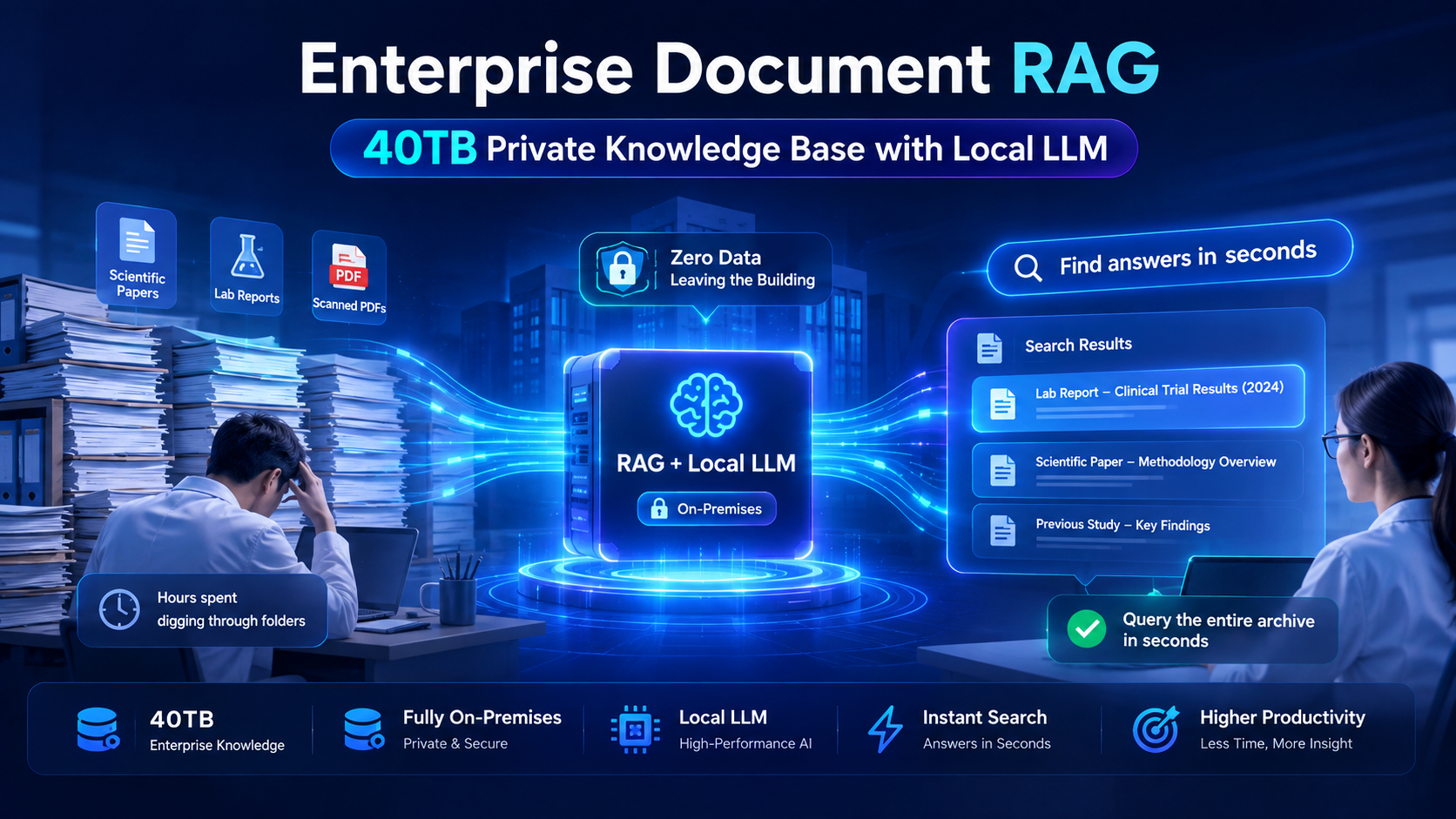
A research-intensive enterprise was sitting on 40TB of accumulated knowledge - scientific papers, lab reports, and scanned PDFs - with no way to search across them intelligently. Employees spent hours digging through folders to find precedents. AMCOLAB deployed a fully on-premises RAG system with a local LLM, making the entire archive queryable in seconds with zero data leaving the building.
The organization had accumulated 40TB of internal knowledge — scientific papers, lab reports, experimental data, and scanned legacy documents. Years of institutional expertise, locked in folders no one could navigate efficiently.
Staff spent hours searching for precedents before starting new work. Relevant documents were missed. Research was sometimes duplicated because earlier findings were effectively invisible. The knowledge existed — it just couldn't be found.
Cloud-based AI was not an option. Strict data residency requirements meant no internal documents could be transmitted to external servers. Any solution had to run entirely within the organization's own infrastructure.
AMCOLAB deployed a fully on-premises knowledge search system — making the entire archive queryable through natural language, with zero data leaving the building. Researchers now find relevant precedents in seconds rather than hours.
All document types — structured PDFs, scanned images, Word files, legacy formats — are processed, chunked, and indexed on internal servers. The pipeline runs on a schedule to incorporate new documents automatically.
A language model runs entirely within the organization's infrastructure. No queries, no document content, and no responses are transmitted to external services. The system works without internet connectivity.
Employees search in natural language — not file names or keywords. The system identifies the most relevant document sections across the full archive and returns them with source citations, so users can verify against the original material.
Department administrators control which document collections each user group can access. Permissions are managed through an admin console without developer involvement.
Field researchers query the knowledge base from a mobile app on approved devices — useful in lab environments where desktop terminals are not always available.
40TB archive made searchable through plain-language queries — folder navigation no longer required
Research retrieval time reduced from hours to seconds for standard queries
Duplicate research efforts reduced — staff verify prior work before starting new studies
Departmental knowledge no longer siloed — cross-team document discovery enabled for the first time
Full compliance with internal data residency policy — zero external data transmission
New researchers onboard faster — institutional knowledge is now accessible rather than locked in individual files
local LLM deployment in air-gapped environments across multiple enterprise projects
designed from the start around the requirement that no data leaves the building
SRS through deployment, with ongoing maintenance of model updates and index management
we advised on what to index first and what to leave out, rather than trying to process everything immediately
We can build the system — entirely on your infrastructure if needed.
Schedule a Meeting Now