AI in Software Development: Optimization Tool or Rewriting the Rules?
Artificial Intelligence is transforming every stage of the software development lifecycle—from requirement analysis and solution design to coding, testing, and operations. While AI dramatically improves productivity and accelerates delivery, it also introduces new challenges around code quality, technical debt, system ownership, and long-term maintainability. This article explores how AI is reshap
AI in Software Development: Optimization Tool or Rewriting the Rules?
Artificial Intelligence (AI) is no longer a futuristic concept or a competitive advantage reserved for a few innovative companies. Today, AI has become an essential part of modern software development and is transforming how teams design, build, test, and maintain digital products.
From requirement analysis and solution design to coding, testing, deployment, and operations, AI is now present throughout the entire software development lifecycle.
But an important question remains:
Is AI simply helping teams work faster, or is it fundamentally changing the way software is built?
The answer is both.
While AI undoubtedly increases productivity, it is also redefining engineering workflows, team responsibilities, and the skills required to build successful software products.
The Rise of AI Across the Software Development Lifecycle
Over the past few years, AI-powered tools have evolved from simple code suggestions into sophisticated assistants capable of generating code, writing tests, analyzing data, detecting vulnerabilities, and even supporting architectural decisions.
Today, software teams use AI for:
- Requirement analysis
- Business data interpretation
- Solution design
- Code generation
- Automated testing
- Bug detection
- Documentation creation
- Infrastructure monitoring
- Operational support
This level of automation has significantly reduced repetitive work and enabled teams to focus more on high-value activities.
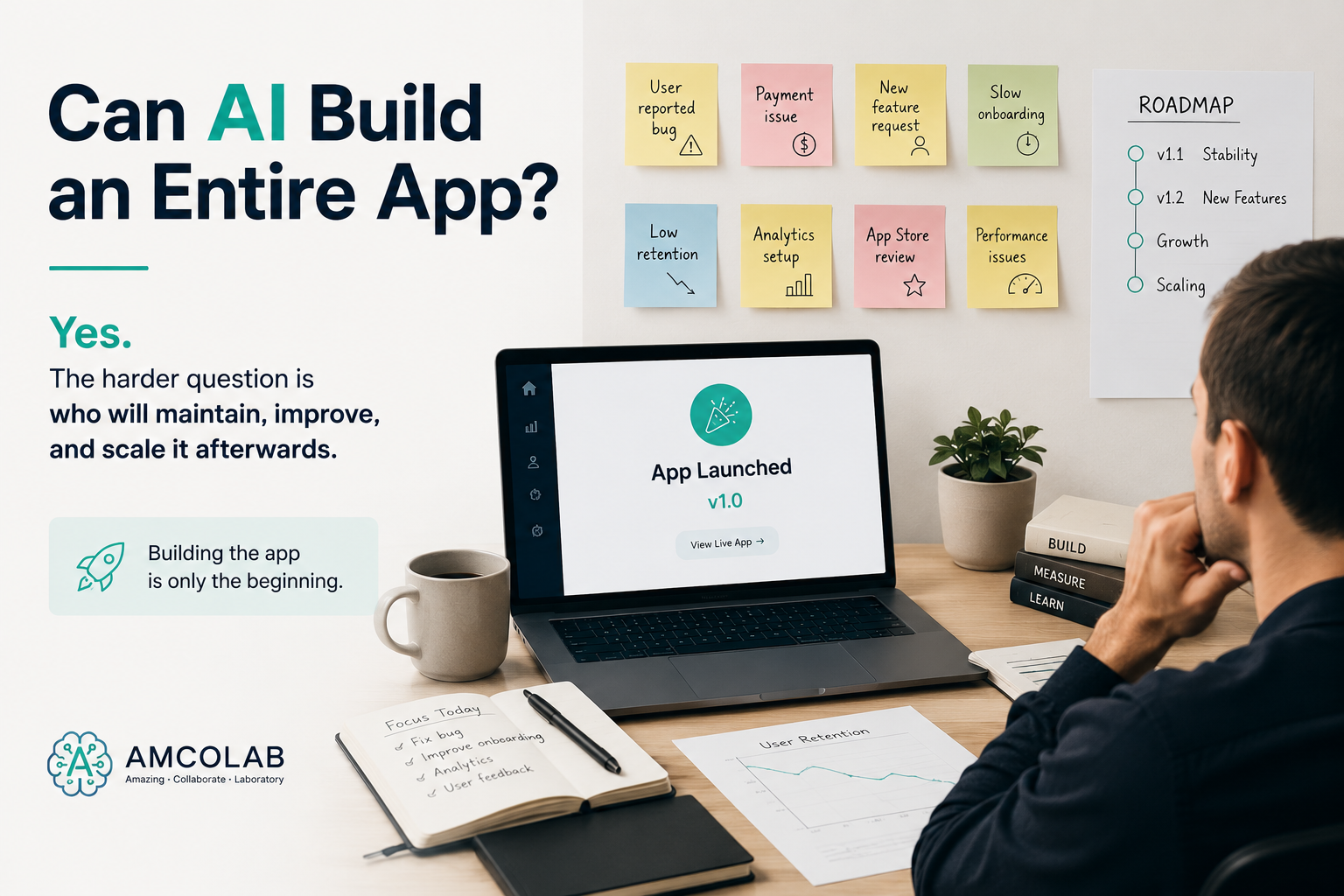
However, increased productivity does not automatically guarantee better software.
In many cases, AI can accelerate both success and failure.
If teams have strong engineering practices, AI amplifies their effectiveness. If teams lack structure, AI can amplify mistakes just as quickly.
Requirement Analysis: AI Can Assist, But Humans Must Understand
One of the earliest and most critical stages of software development is understanding the problem that needs to be solved.
This is also an area where AI is becoming increasingly valuable.
Modern AI tools can analyze large datasets, summarize customer feedback, identify trends, generate requirement drafts, and support documentation efforts.
These capabilities help teams process information faster and reduce manual effort.
However, understanding requirements is not simply about gathering information.
Successful software projects depend on understanding:
- Business objectives
- User needs
- Operational constraints
- Risk factors
- Edge cases
- Long-term product goals
These areas require critical thinking, contextual understanding, and experience.
A poorly defined requirement does not become better because it is implemented faster.
In fact, increased speed often means teams can build the wrong solution more quickly.
That is why high-performing engineering teams do much more than follow specifications.
They actively:
- Analyze business challenges
- Challenge assumptions
- Identify hidden risks
- Explore alternative approaches
- Design scalable solutions
- Align technical decisions with strategic goals
AI can provide insights.
Humans provide judgment.
Development and Testing: Automation at an Unprecedented Scale
Software engineering is arguably the discipline that has experienced the greatest impact from AI adoption.
Developers can now generate code within seconds.
Quality assurance teams can automatically create test cases.
Engineers can receive instant feedback on bugs, security issues, and performance bottlenecks.
Tasks that previously required hours can often be completed in minutes.
The benefits are undeniable:
- Faster development cycles
- Increased productivity
- Reduced repetitive work
- Improved developer experience
- Enhanced testing efficiency
Yet there is a common misconception that faster development automatically leads to better software.
The reality is more complex.
Faster Code Does Not Mean Better Code
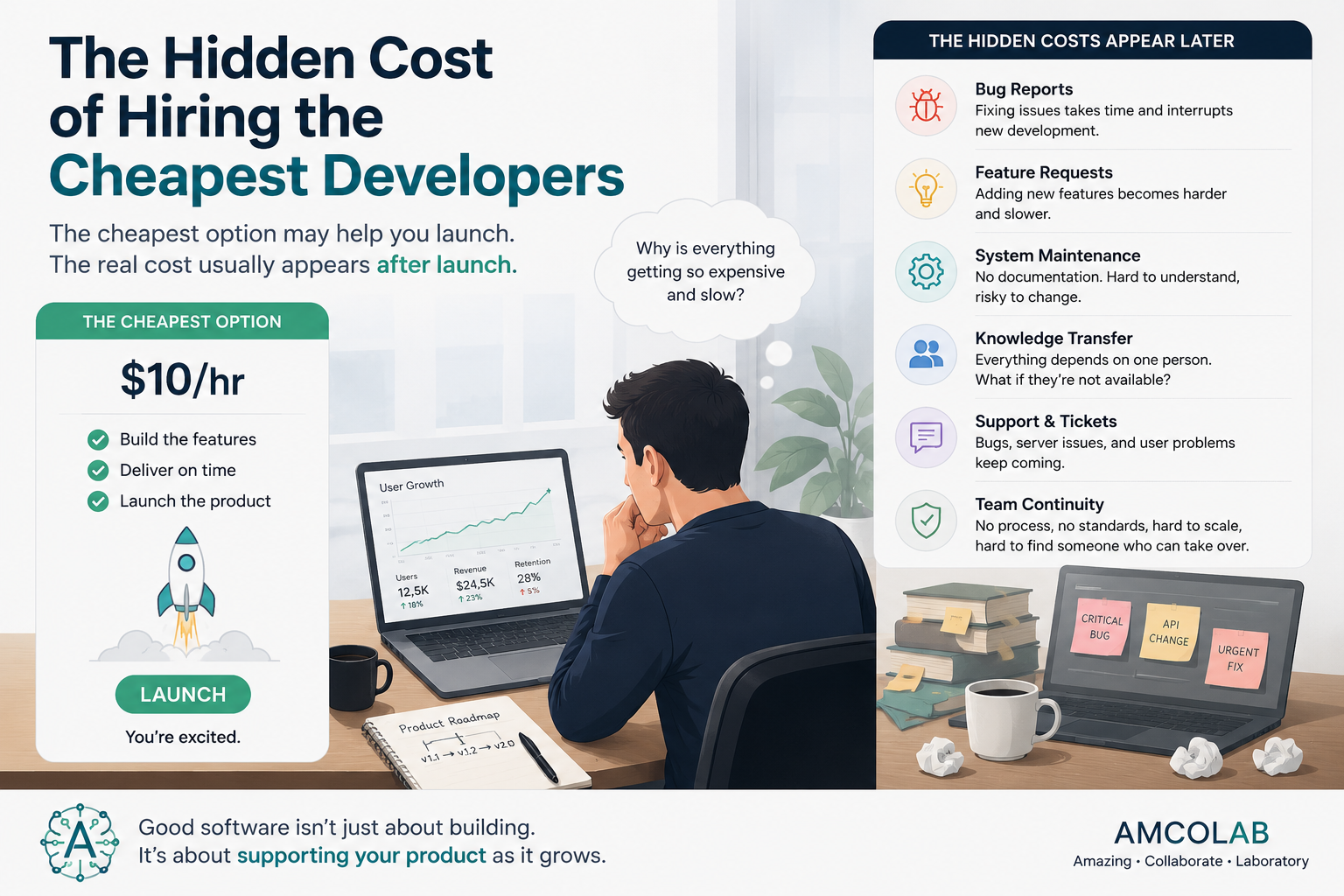
AI-generated code may solve a problem, but that does not guarantee the solution aligns with architectural standards or long-term maintainability goals.
Without proper review processes, organizations may encounter:
Growing Technical Debt
When code is produced rapidly without sufficient oversight, technical debt can accumulate much faster than in traditional development environments.
Architectural Inconsistency
Different AI-generated solutions may approach similar problems differently, resulting in fragmented systems and inconsistent design patterns.
Reduced Ownership
Developers who rely heavily on generated outputs may gradually lose visibility into how systems actually work, making troubleshooting and future improvements more challenging.
Quality Risks
The pressure to move faster can tempt teams to reduce validation, testing, and review processes, increasing the likelihood of production issues.
The objective should never be to produce more code.
The objective should be to create reliable, scalable, and maintainable software.
The Real Challenge Is Not AI — It's Governance
Many discussions focus on whether AI poses risks to software development.
In reality, AI itself is not the problem.
The challenge lies in how organizations implement and govern its use.
Without clear standards and controls, AI can become a shortcut that introduces long-term problems rather than solving them.
As development speed increases, organizations must strengthen their quality assurance processes.
Effective AI adoption requires:
- Coding standards
- Architecture governance
- Security reviews
- Automated testing frameworks
- Human validation processes
- Continuous monitoring
The faster teams move, the more important these guardrails become.
Speed without control creates chaos.
Speed with governance creates competitive advantage.
What Creates Competitive Advantage in the AI Era?
As AI tools become more accessible, simply adopting AI is no longer enough to differentiate a business.
The organizations that gain the most value from AI are not necessarily those using the most tools.
They are the ones that integrate AI effectively into their workflows while maintaining engineering excellence.
Long-term success depends on several key factors.
Strategic AI Integration
Organizations need a clear strategy for where AI creates value and where human expertise remains essential.
Maintaining Quality at Scale
Increased velocity must be balanced with strong engineering standards and quality controls.
Human Expertise
Business understanding, system thinking, architecture design, and strategic decision-making remain fundamentally human strengths.
Ownership and Accountability
Engineering teams must continue to understand and control the systems they build rather than becoming dependent on automated outputs.
The companies that successfully combine AI capabilities with strong engineering culture will be best positioned to succeed.
The AMCOLAB Perspective: AI as a Force Multiplier
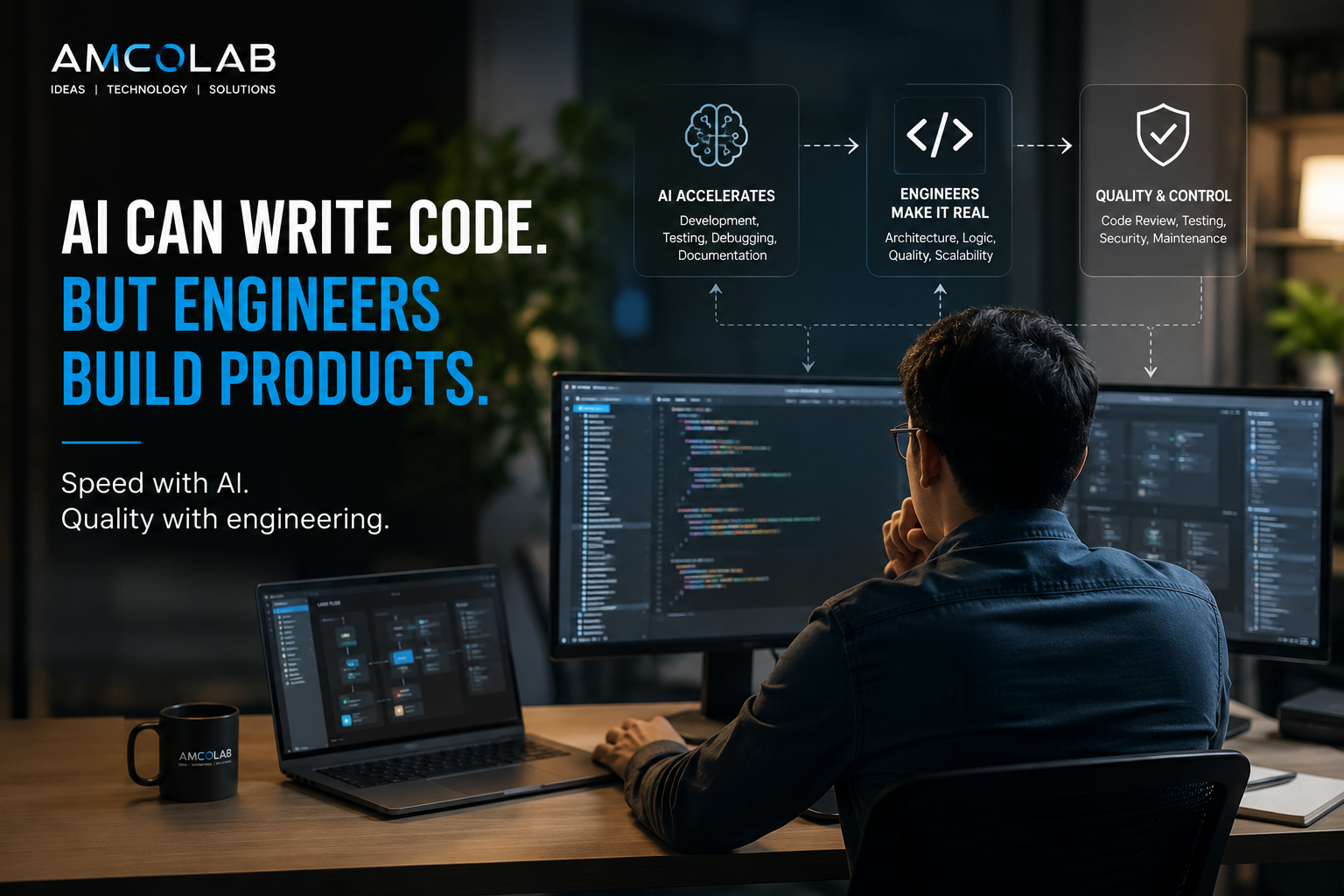
At AMCOLAB, we believe AI should enhance human capability rather than replace it.
We view AI as a force multiplier that allows engineers to spend less time on repetitive tasks and more time solving meaningful problems.
AI can effectively support:
- Code generation
- Test automation
- Documentation
- Routine development activities
Meanwhile, our teams focus on:
- System architecture
- Business logic
- Product strategy
- User experience
- Long-term scalability
- Sustainable software design
Technology can accelerate execution.
Human expertise ensures that the right problems are being solved.
Because successful products are not defined by how quickly they are built.
They are defined by how effectively they solve real business challenges and how well they continue to deliver value over time.
Conclusion
Artificial Intelligence is transforming software development at an unprecedented pace.
It is accelerating workflows, increasing efficiency, and changing how engineering teams operate.
But the future of software development is not about replacing humans with AI.
It is about combining the strengths of both.
Organizations that succeed will not be those that simply adopt AI.
They will be those that use AI strategically, maintain quality as they scale, and ensure their teams remain in control of the systems they build.
In the end, AI is not the competitive advantage.
The competitive advantage is knowing how to use it effectively.
Why Choose AMCOLAB?
AMCOLAB is a technology partner specializing in custom software development, web applications, mobile applications, AI solutions, and digital transformation services.
We help businesses leverage modern technologies, including Artificial Intelligence, while maintaining strong engineering standards, scalable architecture, and long-term sustainability.
Whether you're building a new digital product, modernizing an existing system, or exploring AI-powered solutions, our team is committed to delivering software that creates real business value.
Contact AMCOLAB Technology
✉️ Email: info@amcolab.vn
📞 Tel: (+84) 968 703 531
🌐 Website: https://www.amcolab.vn/
Ready to build smarter software with AI? Contact AMCOLAB today to discuss your next project.